
By the Spectre teamPublished
Most companies enter a new market with the positioning that worked at home, translated. Sometimes it works. More often, the message that made you the challenger at home lands in a market where a local player already owns it, and the launch budget goes into fighting for second place in someone else's conversation.
A better market entry strategy starts earlier and costs less: read the new market's conversation, in its own language, before you decide what to say and where to spend. This playbook shows how, using one hypothetical example throughout: a payments company entering Germany.
Why do home-market playbooks fail in a new market?
Home-market playbooks fail abroad because they answer questions the new market is not asking. The messaging is translated rather than rewritten, the positioning was built against competitors who are not present, and the local leader's real weak spots cannot be seen from headquarters. The result is a launch that fights for a conversation someone else already owns.
Take the payments company. At home it won by being the cheaper, friendlier alternative to the incumbent bank. In Germany a local provider already owns “cheaper and friendlier”. Translating the home message puts the launch in direct competition with the one claim the local leader defends hardest. Three things go wrong at once:
- Translated messaging. The words are German, but the pain point behind them is still the home market's. German buyers may care far more about when the money arrives than about the card fee.
- Borrowed positioning. The challenger story assumes the same incumbent. The incumbent abroad has different strengths, weak spots and enemies.
- Invisible weak spots. From headquarters the local leader looks solid. In the local conversation it is complained about for something specific, every week, and nobody at home is reading it.
What should a market entry strategy be built on?
A sound market entry strategy is built on the conversation the new market is already having: what buyers complain about, which brand they associate with each complaint, and how fast each of those conversations is growing. That evidence shows which position is open before a single piece of creative is briefed.
Total addressable market tells you the size of the prize, not which door is open. Share of voice, measured segment by segment, does, and forecasting where it is heading tells you which door to take first.
How do you enter a new market step by step?
Enter a new market in five steps: listen in the local language, map who owns which conversation per segment, read competitors' ads and the replies underneath, predict how each candidate segment moves over the next 24 weeks, then test small and scale what works. The first four steps happen before any budget is committed.
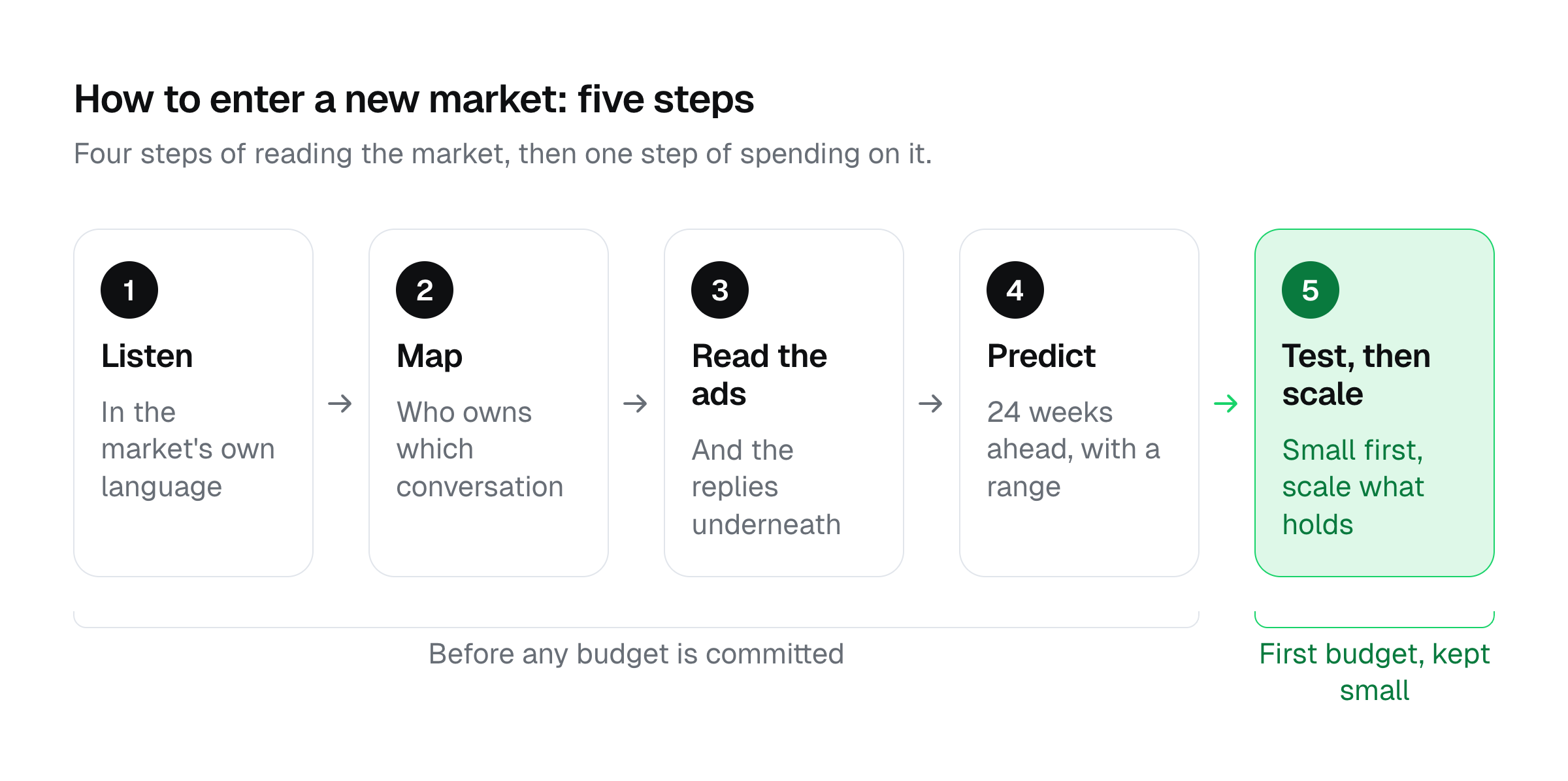
- 1Listen in the local language. Buyers in Germany do not complain about payment providers in English, and the threads that matter are rarely the ones you would guess from home. Collect what buyers post, review, search for and ask AI assistants, in every language the market uses. For the payments company, German-language listening surfaces complaints the home market never had: payouts that arrive late at month end, invoices that do not reconcile, support that only answers in English.
- 2Map who owns which conversation. Group what you find into segments by pain point, in the buyers' own words, and measure share of voice in each. Note whether each conversation is growing or shrinking. Across markets, the overall leader dominates two or three segments and is surprisingly absent from others. In our example the leader owns “checkout conversion” outright but holds almost none of “payout speed”, which is growing fastest. That gap is the entry point.
- 3Read competitors' ads and the replies underneath. Ads tell you which claims a competitor believes in. The replies underneath tell you which claims buyers believe. When the two disagree, you have found a position. The local leader advertises reliability and compliance; under those ads, buyers ask why their money took four days to arrive. The leader's own advertising is pointing at the segment where it is weakest.
- 4Predict before you commit. Pick the three or four segments with the best gap between demand and competition and look at each one 24 weeks ahead. A useful forecast gives a range, not a single number: a conservative, a moderate and an aggressive case per segment, with the effort each needs. For the payments company, the moderate case might take share of voice in “payout speed” from 2% to 18% in 24 weeks, while “checkout conversion” barely moves at twice the effort. That is the launch narrative, and the budget argument.
- 5Test small, then scale. Start with small creative tests against the chosen segment, in the local language, on modest budgets. Keep what earns attention, cut what does not, and feed the results into the next monthly forecast. Within a quarter you know whether the forecast was right, and you have spent a fraction of a full launch campaign finding out.
Which segment should you enter first?
Enter the segment where demand is growing and the local leader is absent or weak. Growing demand means the conversation is getting louder without you. An absent leader means nobody has to be displaced. Segments with a strong leader are expensive to win, and segments with shrinking demand are not worth winning.
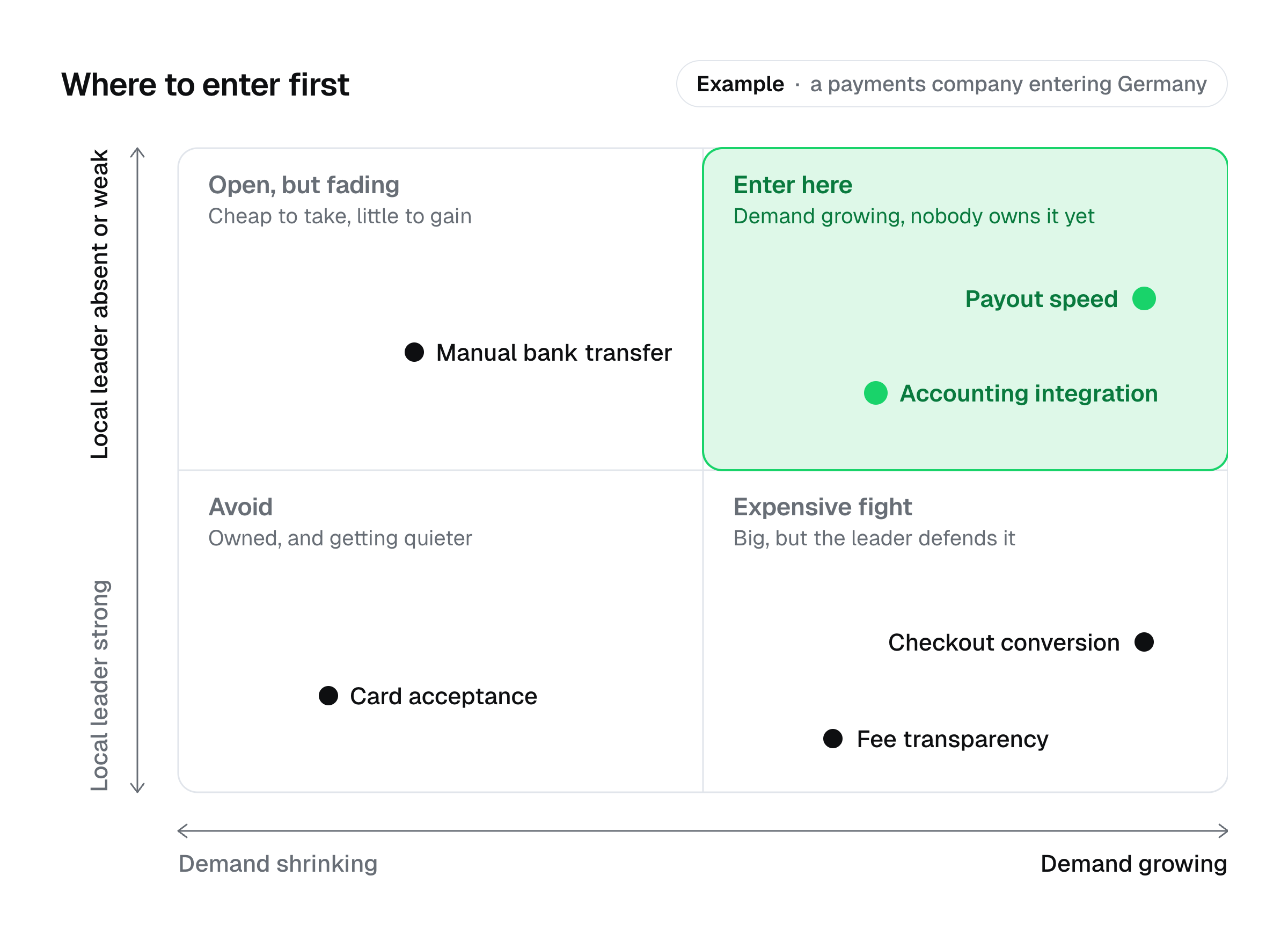
For the payments company, “payout speed” sits in the open quadrant. “Checkout conversion”, the biggest conversation and the home team's instinct, is the expensive fight. It becomes the second move once the brand has a foothold.
What goes on a market entry checklist?
A market entry checklist asks whether you can name the segment you are entering, who owns it today, what buyers say about the leader, how the segment is forecast to move, and what you will measure monthly. If any answer begins with “we assume”, the launch is not ready.
| Question | Why it matters | What good looks like |
|---|---|---|
| What are the five biggest pain-point segments? | Segments, not the whole market, decide where you can win. | Each segment named in buyers' words, with its size and direction. |
| Who owns each segment today? | The overall leader is rarely the leader everywhere. | Share of voice per segment, per competitor. |
| What do buyers say under competitors' ads? | Replies expose the gap between a claim and the experience. | A list of disputed claims, by competitor. |
| How will the chosen segment move over 24 weeks? | Spend should follow the forecast, not the loudest opinion. | Conservative, moderate and aggressive cases, with the effort each needs. |
| What is the launch narrative? | Everything produced should point at one open position. | One sentence, in the buyers' language, that no local competitor can say. |
| What gets measured monthly? | A forecast is only useful if it is checked. | Share of voice per segment against the forecast, every month. |
What should you bring to the board before launch?
Bring the board a forecast, not a plan. Show the segment you are entering, who owns it today, the 24-week range for your share of voice under three levels of effort, and the monthly checkpoint that shows whether the forecast is holding. That turns a launch into a decision the board can test, not a bet to trust.
- The segment map. Five to eight pain-point segments with size, direction and owner.
- The open position. The segment with growing demand and a weak leader, with the evidence from competitors' ads and the replies underneath.
- The forecast. Conservative, moderate and aggressive cases for share of voice at 24 weeks, with the effort behind each.
- The test plan. What gets tested first, for how long, and which result would stop or scale it.
- The checkpoint. The monthly refresh that confirms or corrects the forecast.
Once the forecast is on the table, the board stops debating whether Germany is a good idea and starts debating which case to fund. Spectre refreshes the forecast monthly, so the checkpoint is built in, and market entry is where it earns its keep fastest.
What are the most common market entry mistakes?
The most common market entry mistakes are translating the home message instead of rewriting it, choosing the segment the leader is strongest in because it is the biggest, listening only in English, launching on a single number instead of a range, and skipping the monthly check that would show the forecast was wrong early enough to fix.
- Launching into the leader's strongest segment because it is the biggest. Big and owned is the most expensive place to start.
- Trusting the home sales team's view of local competitors. They know the rivals from home, not the ones who matter abroad.
- Spending on awareness before position. Awareness for a message nobody locally wanted is awareness wasted.
Your market already exists. The conversation is already happening. The only question is whether you read it before or after you spend.
Frequently asked questions
How long does it take to read a new market before launch?
Less time than most launch plans give to creative. Listening and segment mapping in a market's own language takes days once it is set up, and a first forecast takes about a week. The slow part is usually internal: agreeing to let the evidence choose the segment rather than the home-market instinct.
Does this replace traditional market research?
No, it fills the gap between research and spend. Classic research tells you the size of the market and what buyers say when asked. Reading the live conversation tells you what they say when nobody is asking, who they blame, and which way each complaint is heading. They answer different questions, and a launch needs both.
What if the local leader is strong in every segment?
It is rarer than it looks from headquarters. When it happens, the answer is usually a segment too small for the leader to bother with and growing fast. Enter there, build share of voice, and let the forecast show when an adjacent segment opens. Going head-on at a leader who owns everything is a budget decision, not a strategy.
How do you know whether the market entry is working?
Share of voice per segment, checked monthly against the forecast, is the earliest honest signal. It moves before traffic and long before revenue. If the chosen segment is tracking the moderate case, scale. If it sits below the conservative case for two months, the narrative or the segment is wrong, and most of the budget is still unspent.
See what Spectre would say about your market.
30 minutes. Bring the market you're entering or the competitor you're up against.