
By the Spectre teamPublished
Ask a marketing team how this quarter’s plan was decided and you will usually hear three things: what worked last time, what competitors seem to be doing, and what the most senior person in the room believed. All three look backwards, and the market you are about to spend in has not happened yet.
Predictive marketing changes the order. Before the budget is committed, you forecast how your market is likely to move and where your effort will change that movement most. Then you plan against the forecast and check it against reality every month.
What is predictive marketing?
Predictive marketing is the practice of planning marketing from a forecast of how your market will move, rather than from a report of what it did last quarter. You read where buyers talk, search and ask, predict how each audience segment is likely to shift over the coming months, and put effort where it changes the outcome most.
The forecast is about the market, not revenue or individual leads: how much buyers will be talking about a given pain, who will own that conversation, and how far a focused effort could shift your share of it in a fixed window, typically 24 weeks. All three can be measured now and measured again later, which is what makes the forecast checkable.
How is predictive marketing different from reporting and analytics?
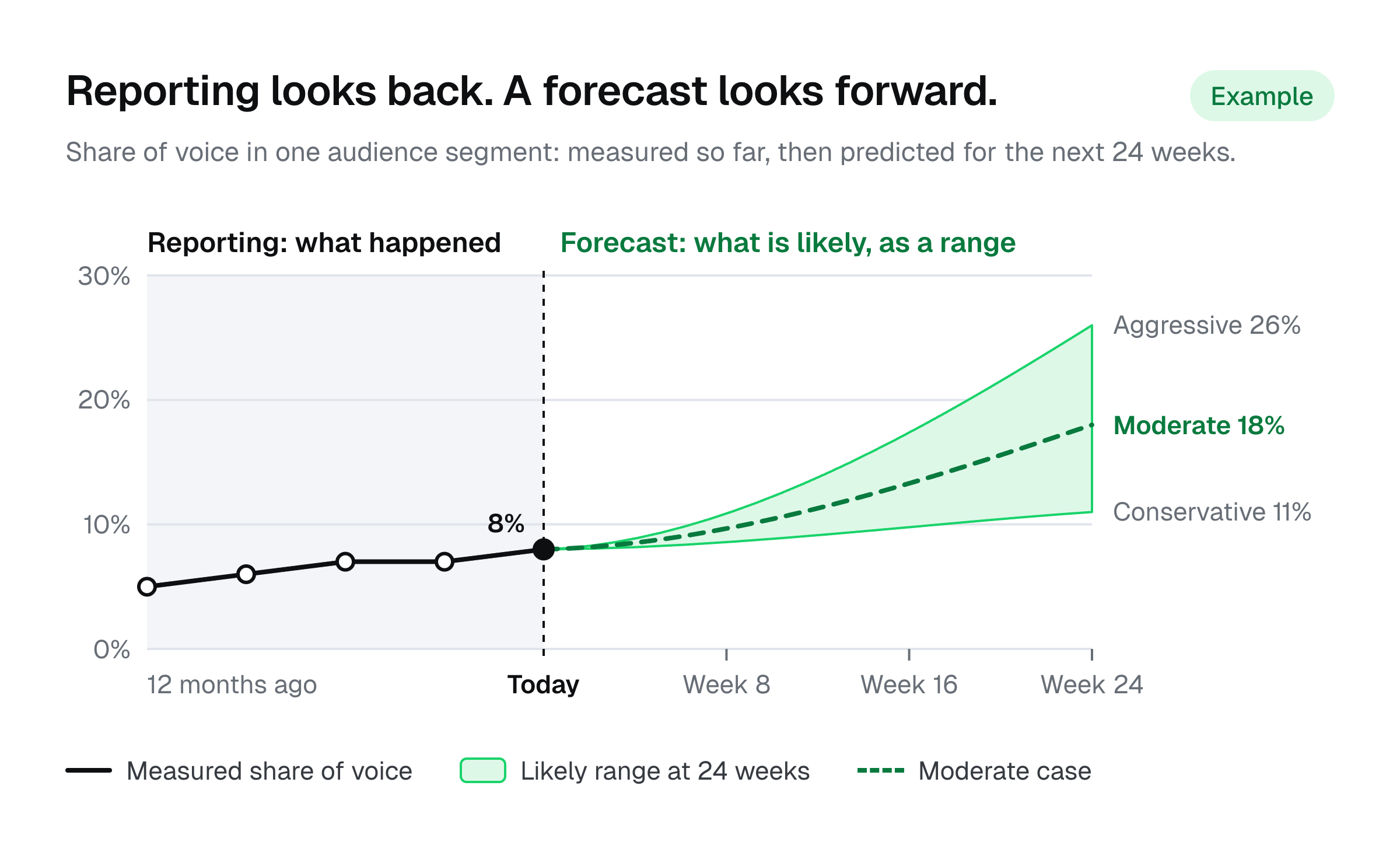
Reporting tells you what already happened: sessions, leads, cost per lead. Predictive marketing tells you what is likely to happen next and where you can change it. Reporting is backward-looking and exact. A forecast is forward-looking and comes as a range. You need both, but only one of them can shape a plan before the money is spent.
Most dashboards are built from lagging numbers: useful for tuning campaigns already in flight, nearly useless for deciding where to go next, because by the time they move, the budget has been spent.
| Reporting and analytics | Predictive marketing | |
|---|---|---|
| Question it answers | What happened? | What is likely to happen, and where can we change it? |
| Form of the answer | Exact numbers | A likely range with a confidence level |
| Unit of analysis | Channels and campaigns | Audience segments defined by buyer pain |
| Most useful for | Tuning work already in flight | Deciding where to focus before the budget is committed |
The two are not rivals. Reporting is how you check a forecast. If the plan said a segment would reach around 19% share of voice in 24 weeks and the monthly report shows 6% after twelve, that is the most useful number on the dashboard.
What does a predictive marketing plan actually look like?
A predictive marketing plan has four parts: audience segments defined by the pain buyers describe in their own words, share of voice measured inside each segment, a 24-week forecast for each segment given as a range rather than a single number, and a ranked list of where focused effort will pay off most. Everything else hangs off that list.
- 1Segments defined by buyer pain, in the buyer’s words. Not “mid-market finance teams” but “we’re drowning in spreadsheets”. Each has a size (how much people talk about it) and a direction (growing or shrinking), and maps directly onto a message.
- 2Share of voice per segment. Of all brand mentions inside one segment’s conversation, how many are yours and how many belong to each competitor. The overall leader is usually absent from two or three growing segments. Share of voice per market hides those gaps; per segment, it shows them.
- 3A 24-week forecast, given as a range. Where your share of voice is likely to be if you focus on the segment, with a conservative, moderate and aggressive case and a confidence level. A wide range is the forecast being honest about an uncertain segment.
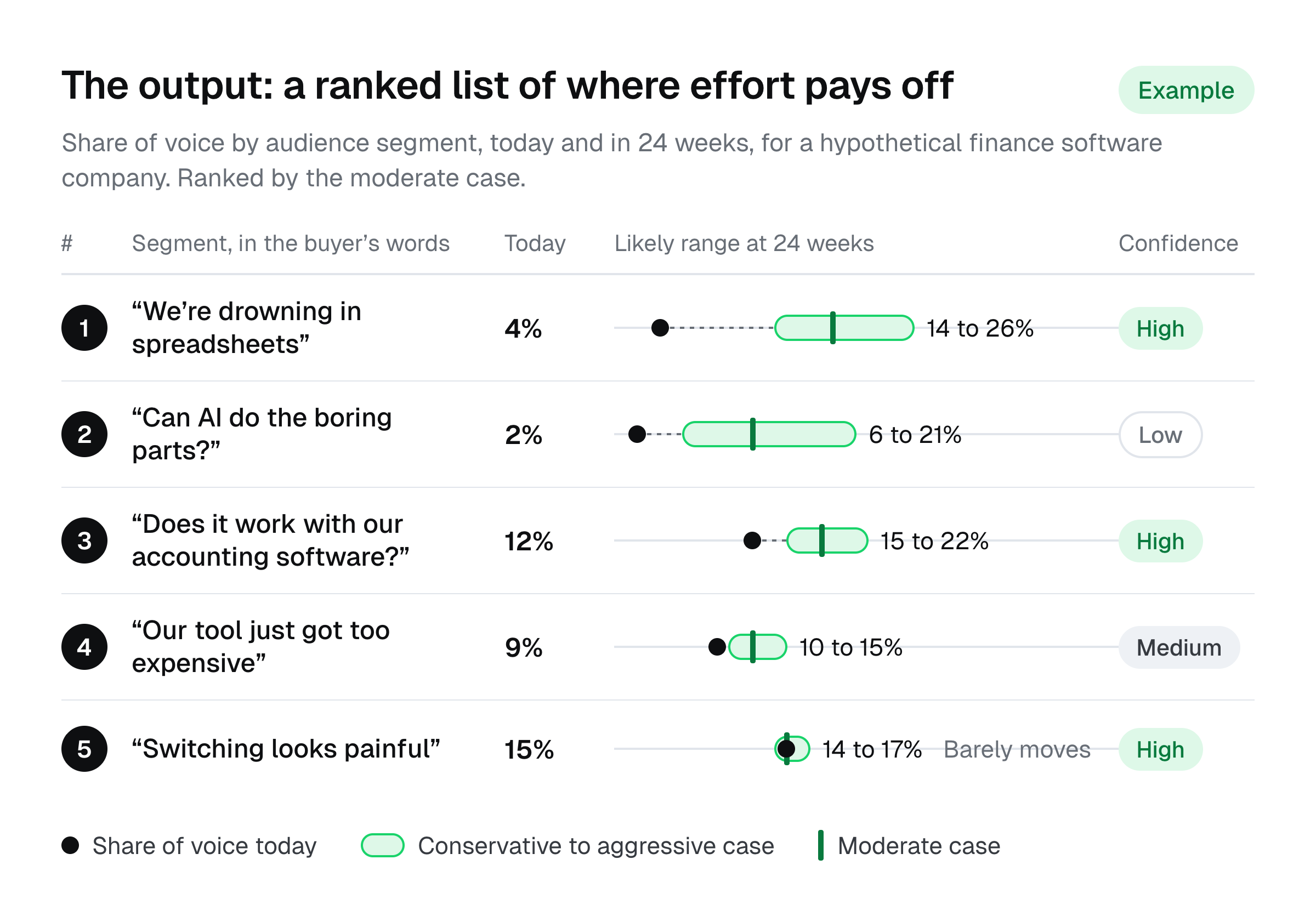
- 4A ranked list. Segments ordered by how far they are likely to move for the effort available, weighed by confidence. Segment one gets the narrative, pages, content and ads. The segment that barely moves gets nothing, and that is now a decision you can defend.
What does predictive marketing look like in practice?
Take a hypothetical accounting software company entering the Netherlands. Reporting from its home market says the winning message is compliance. Reading the Dutch conversation first shows that compliance is a segment the local leader already owns, while the fastest-growing segment, teams leaving spreadsheets, has no clear owner. The forecast ranks that segment first.
The company holds 4% share of voice in the spreadsheet segment today. A focused 24-week effort takes it to between 14% and 26%, moderate case around 19%, with high confidence because the segment is growing and nobody dominant is speaking to it. The AI segment could move almost as far, but its range is wide and its confidence low. The segment the home playbook would have chosen already gives the company 12%, but the leader owns it and the likely gain is modest.
So the plan puts the narrative, pages, content and first ads behind the spreadsheet segment, keeps a small test on the AI segment to tighten its range, and leaves the rest alone. Every month the forecast is refreshed and checked against the path it predicted. In Spectre, the first forecast arrives about a week after kick-off.
When does predictive marketing pay off most?
Predictive marketing pays off most when you are about to do something you have not done before, because that is when last quarter’s report has the least to say. Four moments stand out: entering a new market, launching a product, responding to a competitor who has just moved, and planning a budget you will have to justify to the board.
- A new market. The position that made you the challenger at home may already be owned by a local player. Entering a new market covers the playbook.
- A product launch. A forecast shows which pain segment the launch should attach to, which is often not the one the roadmap assumed.
- A competitor move. The instinct is to respond everywhere. The forecast shows which segments the move actually opens or closes.
- Budget planning. A CFO will accept a forecast with a range and a track record far more readily than last year plus ten per cent.
The use cases page covers all four.
What makes a forecast trustworthy?
A trustworthy marketing forecast gives a range rather than a single number, states its confidence for every segment, is refreshed monthly as the market moves, is checked openly against what actually happened, and leaves the decision with people who know the brand. A forecast missing any of these is a guess with a chart.
- Ranges, not points. A single number invites false precision.
- Confidence per segment. Commit hard where the call is solid, test small where it is early.
- Refreshed monthly. A forecast made once is a snapshot. Refreshed as the market moves, it is a plan.
- Checked against reality. If the forecast is never wrong, nobody is checking.
- Humans decide. People who know the brand choose, and a human approves every piece of work before it ships.
What is predictive marketing not?
Predictive marketing is not a crystal ball, not a content generator and not a replacement for judgement. It will not tell you next quarter’s revenue or write your campaign for you. It narrows the question of where to focus to a ranked list with ranges, and hands that list to people who decide.
Nor is it market research in a new coat: research asks people and describes a point in time, while prediction reads what people say unprompted and projects it forward. Predictive marketing versus market research has more. Production comes after prediction has set the aim, by your team, your partners, or our team and agents at Spectre, with a human approving every piece.
What should you ask before adopting predictive marketing?
Before adopting predictive marketing, ask five questions: what exactly is being forecast and over what window, whether it comes with ranges and confidence, how often it is refreshed and checked against results, who defines the segments and in whose words, and who decides what happens with the ranked list.
- 1What is being forecast, over what window? Share of voice per segment over 24 weeks is checkable. “Growth” is not.
- 2Ranges and confidence, or one number? Ask to see the conservative and aggressive cases side by side.
- 3How often is it refreshed, and how did the last one track? Monthly, with a past forecast shown next to what happened.
- 4Who defines the segments, in whose words? The market’s own language, including languages your team does not speak.
- 5Who decides, and what does it need from us? Your people decide. Ask what data is required and who signs it off.
Predictive marketing does not make marketing certain. It makes the plan a forecast you can check instead of an opinion you have to defend. That is the difference between arguing about the past and planning the next 24 weeks.
Frequently asked questions
Is predictive marketing the same as predictive analytics?
Not quite. Predictive analytics usually scores leads or customers already in your database: who will convert, who will churn. Predictive marketing looks outward: which segments are growing, who owns each conversation, and how far a focused effort could shift your share of voice over a fixed window.
How far ahead can predictive marketing forecast?
Far enough to plan a quarter and check it, which is why 24 weeks is a common window. Shorter, and the forecast cannot see a campaign through. Longer, and the range widens until it stops being useful. Monthly refreshes keep the window moving with the market.
What data does predictive marketing need?
A read of where your market talks, searches and asks, in every language it uses: social conversation, search, questions put to AI assistants, and competitors’ ads. It is stronger with your own customer and pipeline data alongside. A serious provider will walk your legal and security teams through what is used and how it is handled.
How do you know if a predictive marketing forecast was right?
Compare it with what happened. If a segment was forecast to move from 4% to between 14% and 26% share of voice in 24 weeks, the monthly measurement shows whether it is on that path. Over a few cycles you learn where the forecast tends to be early or late.
See what Spectre would say about your market.
30 minutes. Bring the market you're entering or the competitor you're up against.