
By the Spectre teamPublished
Marketing leaders have four ways to read a market before spending against it. Three are decades old: market research, social listening and marketing analytics. The fourth, predictive marketing, is newer and often confused with the other three.
This is a neutral overview of all four. Each answers a different question, looks at a different slice of time and produces a different output. None replaces the others; the useful question is which one to ask.
What are the four types of marketing intelligence?
Marketing intelligence comes in four broad types: market research (asking people what they think), social listening (monitoring what people say unprompted), marketing analytics (measuring what your own marketing did) and predictive marketing (forecasting where the market and your results will move next). They differ mainly in the question they answer and the time they look at.
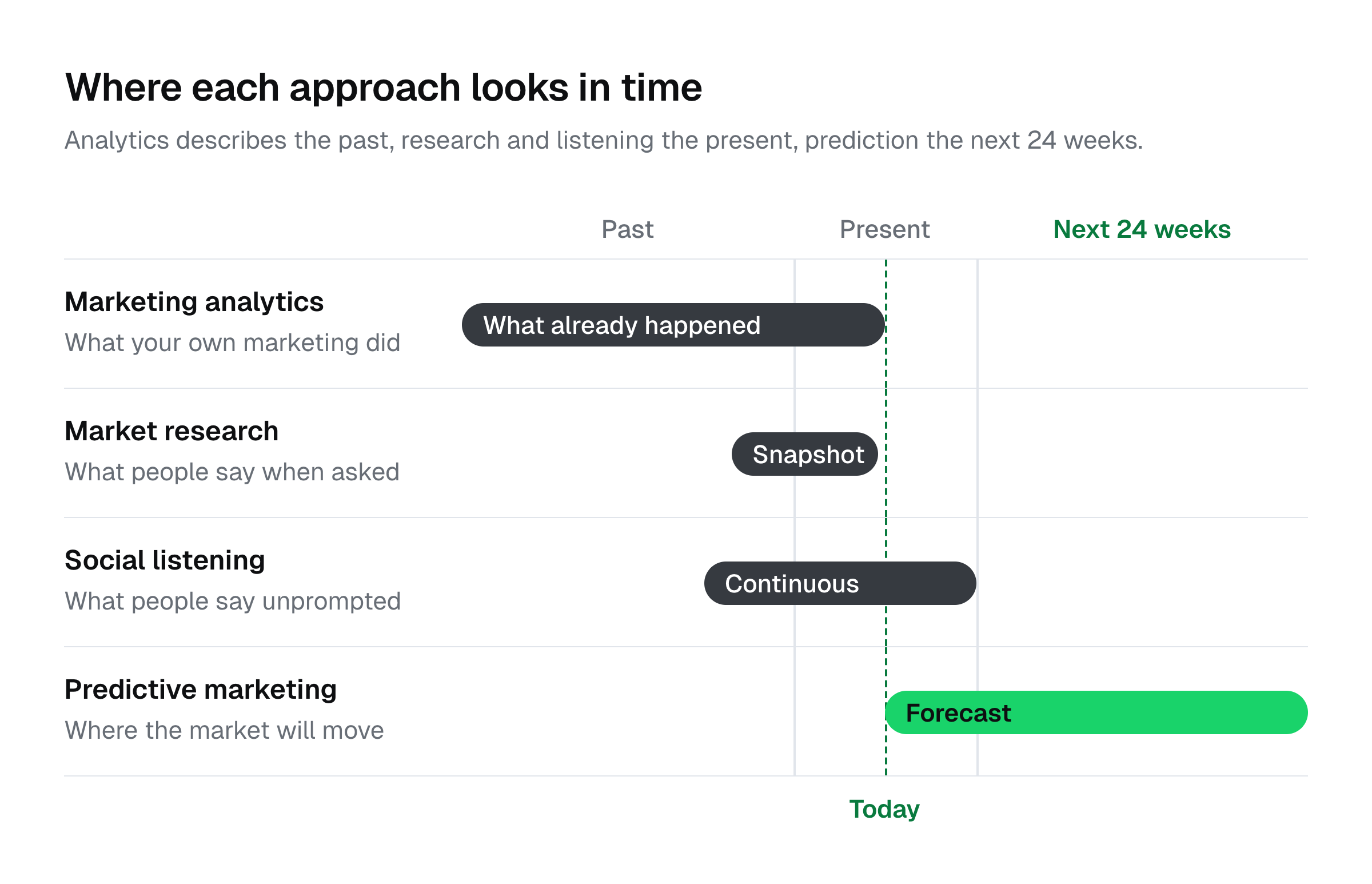
The simplest way to tell them apart is by time, as the diagram below shows.
What is market research?
Market research is the structured practice of asking people questions to understand what they want, believe and are likely to do. It uses surveys, interviews, panels and focus groups, and it answers “why” questions: why buyers choose one option over another, what they value, and how a message lands before it ships.
Looks at: the present, as a snapshot. It captures what people believed on the day they were asked; the report lands weeks later. Output: a report: personas, segment sizing, concept scores, price sensitivity.
Strengths: depth and causation. You can ask follow-up questions, test a message nobody has seen yet, and reach people who never post online, which matters in quiet categories such as insurance.
Blind spots: people are unreliable narrators of their own behaviour: they say they would pay and then do not. And most organisations do it once a year, so it cannot say what changed last month.
Use it when: a decision is costly to reverse, such as a repositioning or a new product line, and you need the reasons behind buyer behaviour.
What is social listening?
Social listening is the continuous monitoring of public conversation about your category, your brand and your competitors: mentions, comments, reviews, threads and questions, wherever your market talks, searches and asks. It answers what is being said right now, by whom and about whom, without anyone being prompted to say it.
Looks at: the present, continuously. A complaint about a competitor's price rise shows up the day it happens, not in next year's tracker. Output: themes, sentiment, mention counts and share of voice.
Strengths: it is unprompted, so it catches language and problems you did not think to ask about. It shows how competitors are perceived, not just how you are.
Blind spots: it only hears people who talk in public. Volume is noisy: a thousand posts can come from fifty angry people. And it tells you what people are saying, not what they will do.
Use it when: you need an early warning, a check on how your message is landing, or a fast read on a market you have not entered yet.
What is marketing analytics and reporting?
Marketing analytics and reporting is the measurement of your own marketing performance: traffic, leads, pipeline, cost per acquisition, conversion rates and attribution, usually presented as dashboards. It answers what your marketing did and what it returned, with a precision none of the other approaches can match.
Looks at: the past, up to today. Every number on a dashboard describes something that has already happened, even when it updates in real time. Output: dashboards and reports: channel and campaign performance, funnel conversion, attribution.
Strengths: it is your own data: specific, measurable and hard to argue with. It is the right tool for steering live campaigns, and it is what finance expects to see.
Blind spots: it can only report on what you have already tried. And it says nothing about the market around you: a 20% rise in leads looks like a win until you learn the category grew 60%.
Use it when: you are optimising activity that is already live, reporting results, or deciding what to stop.
What is predictive marketing?
Predictive marketing is the practice of forecasting how a market is likely to move over a defined period, typically the next 24 weeks, and where marketing effort is most likely to change the outcome. It answers where you should spend next and what you should expect, before the budget is committed.
Looks at: the future. It projects where each segment is heading and how much effort would move it. Output: a ranked forecast per segment: current and predicted position, the range around it and the confidence behind it. A payments company entering a new country might, for example, see one segment forecast to double with no clear leader and another to stay flat whatever it spends.
Strengths: it turns a budget debate into a comparison of forecasts and forces a choice between segments. Because every forecast carries a date, it can be checked: in 24 weeks you know whether it was right.
Blind spots: a forecast is a probability, not a promise. It cannot explain why buyers feel the way they do (research's job), nor what your campaign did last week (analytics' job). See what is predictive marketing? for a longer introduction.
Use it when: you are about to commit budget to something new: a market entry, a product launch, a competitor's move, or next year's plan in front of the board.
How do the four approaches compare?
The four approaches differ on five things: the question they answer, the time they look at, the output they produce, the decision they are best for and what they cannot see. The table sets them side by side, so you can see which gap each one leaves and which one fills it.
| Approach | Answers | Looks at | Output | Best for | Blind spot |
|---|---|---|---|---|---|
| Market research | Why do buyers think and choose as they do? | Present, a lagged snapshot | Report: personas, sizing, concept scores | Costly, hard-to-reverse decisions | Stated intent is not behaviour; slow and sampled |
| Social listening | What is the market saying now, and about whom? | Present, continuously | Themes, sentiment, mentions, share of voice | Early warning, message checks, new markets | Only hears the vocal; volume is not demand |
| Marketing analytics | What did our marketing do and return? | Past, up to today | Dashboards, funnel, attribution | Steering live campaigns, reporting | Blind to anything untried and to the wider market |
| Predictive marketing | Where will the market move and where does effort pay off? | Next 24 weeks | Ranked forecast per segment, with confidence | Budget allocation before commitment | A probability, not a promise; cannot explain why |
How do the four approaches fit together?
The four approaches are complementary, not competing. A sensible stack uses listening to hear the market, research to understand it, prediction to decide where to spend and analytics to check whether the spend worked. Each one covers a blind spot in another, and the output of one is the input to the next.
- 1Listen first. Listening gives you the market's own words, the growing segments, and where competitors are absent.
- 2Research what matters. Where the stakes are high, use interviews or a survey to learn why those buyers think as they do.
- 3Predict before committing. Forecast where each candidate segment is heading and what effort would move it, then fund the ranked few.
- 4Measure the work. Analytics tracks what went live and what it returned.
- 5Compare results with the forecast. Correct it where they diverge, and start the next cycle.
Few teams do all four well, and that is fine, as long as you know which question each answers. Budget planning is where they meet most often; the budget planning use case walks through that meeting.
Which approach answers your question?
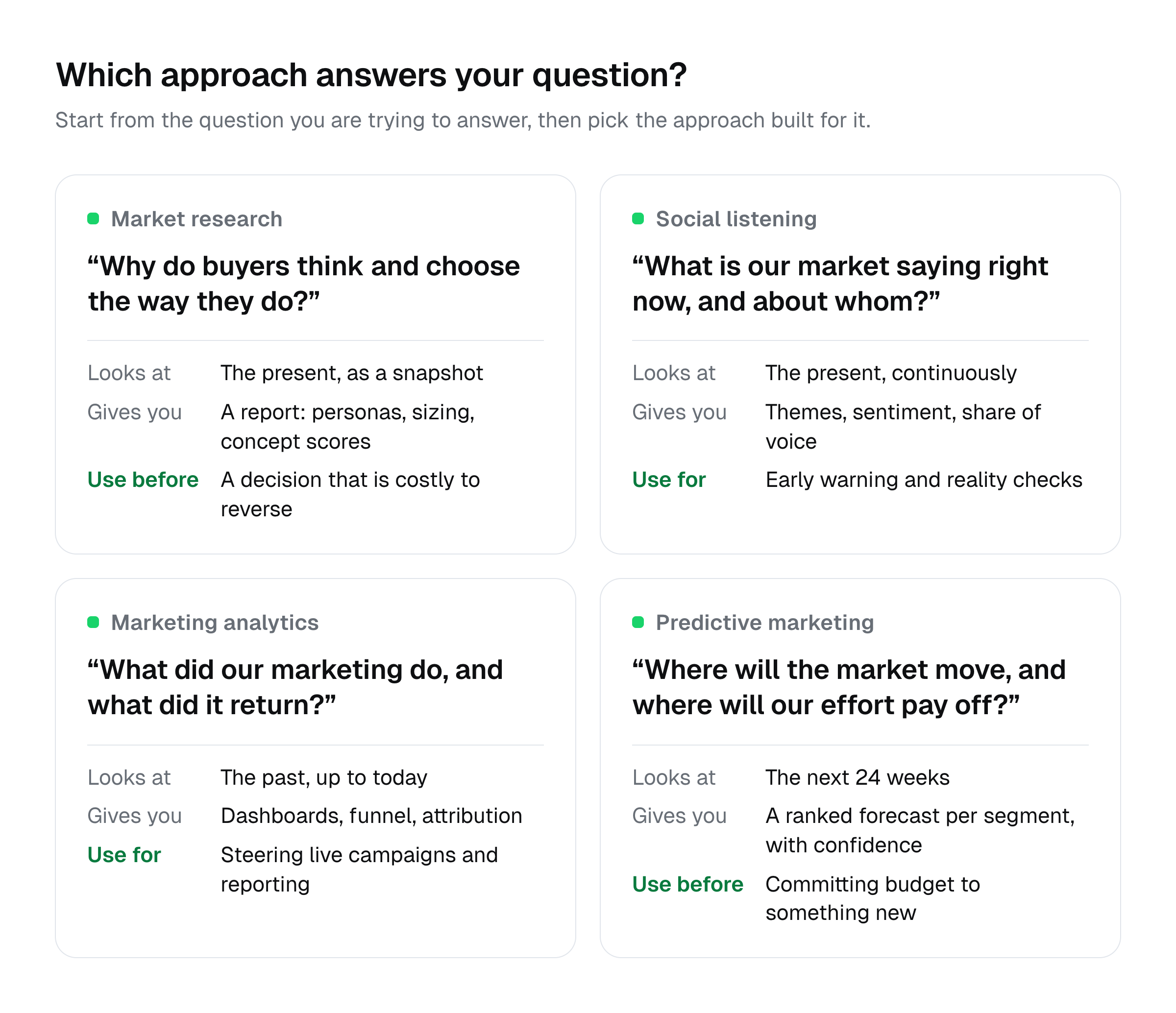
Start from the question, not the tool. If the question begins with “why”, use research. If it begins with “what are people saying”, use listening. If it begins with “what did we get”, use analytics. If it begins with “where should we spend next” or “what will happen if”, use prediction.
What are the most common mistakes?
The most common mistakes come from asking an approach a question it cannot answer: asking a dashboard about the future, treating listening volume as proof of demand, and treating a forecast as a guarantee. Each approach is reliable inside its own question and misleading outside it.
- Asking a dashboard about the future. Last quarter's cost per lead says what a channel did, not what it will do in a market that has moved, and nothing about channels you never used.
- Treating listening volume as demand. Mentions measure attention, not intent. A loud segment can be small, and a quiet one can be where the budget belongs.
- Treating a forecast as a promise. A forecast comes with a range and a confidence level. Plan for the moderate case and know what the conservative one looks like.
This post is published by Spectre, which sits in the prediction column; everything above holds whether or not you ever use it.
Frequently asked questions
Is predictive marketing a replacement for market research?
No. Research explains why buyers think and act as they do, through direct questions. Prediction forecasts where the market and your results are heading. One supplies causes, the other direction. The strongest plans use research to understand the segments a forecast says matter most, and the forecast to decide which gets budget.
What is the difference between social listening and market research?
Social listening overhears what people say in public, unprompted and continuously. Market research asks people directly, in a structured way, at a point in time. Listening is faster and better at catching surprises. Research is deeper, reaches the silent majority and can test things nobody has seen yet. Most organisations need both.
What is the difference between market research and marketing analytics?
Market research studies the market: buyers, attitudes, needs and competitors, usually by asking people. Marketing analytics studies your own activity: what your campaigns, channels and content did and what they returned. Research looks outward at the present; analytics looks inward at the past. Neither tells you where to spend next.
How often should each approach be refreshed?
Analytics is continuous by nature. Social listening should be continuous too. A forecast should be refreshed at least monthly, because the market it describes keeps moving. Deep market research is usually annual or tied to a major decision, so it should be the foundation of a plan rather than its steering wheel.
See what Spectre would say about your market.
30 minutes. Bring the market you're entering or the competitor you're up against.