
By the Spectre teamPublished
Most marketing dashboards are full of numbers that describe the past: sessions, leads, cost per lead. They are good for running campaigns and poor for deciding where to go next, because by the time they move, the decision has already been made.
Share of voice is different. It measures how much of your category's conversation is about you, and it tends to move before revenue does. Here is how to calculate it, how it relates to share of market, and how to forecast it.
What is share of voice?
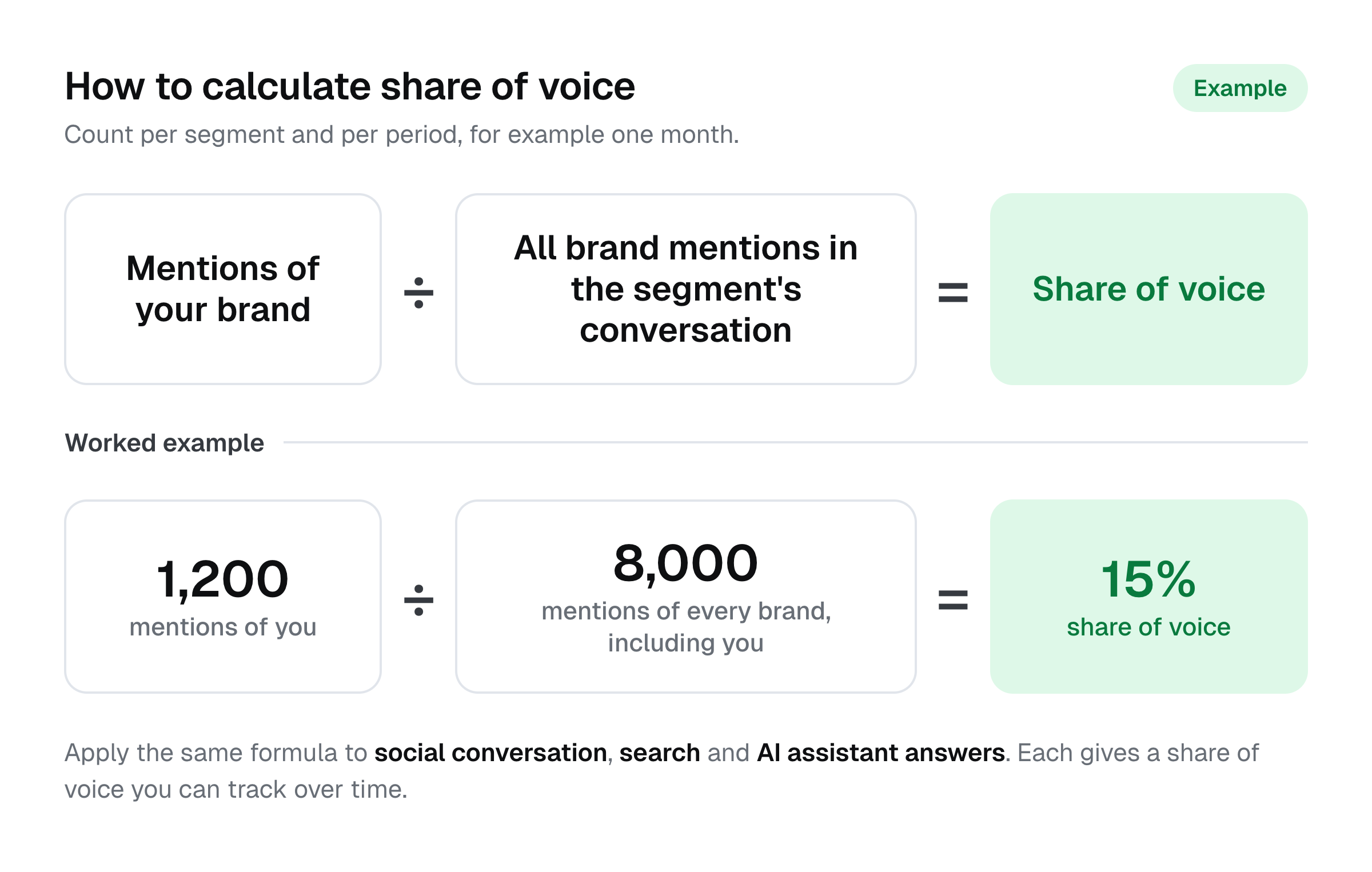
Share of voice is the percentage of all brand mentions in a category conversation that belong to your brand, measured over a set period. If buyers in your category mention brands 8,000 times in a month and 1,200 of those mentions are yours, your share of voice is 15%.
The term started in advertising, where it meant your share of the category's ad spend. The version that matters now counts what the market actually says: the posts and reviews where buyers talk, the searches they type, and the brands AI assistants name when asked for a recommendation. On every surface the question is the same: of all the times a brand came up, how often was it you? And because attention comes before purchase, the number moves before revenue does.
How do you calculate share of voice?
Divide the number of mentions your brand received in a period by the total number of brand mentions in the same conversation, including your own, and multiply by 100. Do this per segment and per period, for example monthly, so you can see the level and the direction at the same time.
- 1Define the conversation. The market, the language and the segment: a pain point in the buyer's own words, such as teams leaving spreadsheets.
- 2List every brand competing for it, including yours. Leave one out and everyone else's share inflates.
- 3Count mentions of each brand in the period: posts, comments, reviews, searches, answers.
- 4Divide your count by the total and multiply by 100. Repeat for each competitor.
- 5Repeat next period. One reading is a snapshot. Two are a direction.
The same formula works on three surfaces: social conversation, where buyers talk about the category; search, your brand's searches against every brand's; and AI assistants, how often you are among the brands named when someone asks for a recommendation. Keep the three readings separate, because a brand can be strong in one and invisible in another.
Share of voice vs share of market: what's the difference?
Share of market measures the sales you already have: your revenue or units as a percentage of the category total. Share of voice measures the attention you are getting now. Share of market describes the past. Share of voice points to the future, because attention tends to turn into sales over the following quarters.
| Share of voice | Share of market | |
|---|---|---|
| What it counts | Mentions of your brand in the category conversation | Your sales as a share of category sales |
| What it tells you | How much attention you hold now | How much business you have already won |
| Timing | Leading: moves before revenue | Lagging: moves after the decision |
| How often it updates | Weekly or monthly | Quarterly or yearly |
| Best use | Deciding where to invest next | Reporting what the last plan delivered |
The link between the two is one of the most widely cited principles in marketing. Brands whose share of voice is higher than their share of market tend to gain market share over time. Brands whose share of voice is lower tend to lose it. The gap is sometimes called excess share of voice, and its sign tells you which way the brand is heading.
That turns share of voice into a budget argument. Hold 7% of the market and 4% of the conversation, and next year's outlook is not kind. Hold 7% of the market and 12% of a growing conversation, and you have a case for investing ahead of revenue, with a number the CFO can check. That is budget planning with a forecast instead of an opinion.
Why should you measure share of voice per segment?
One share of voice number for a whole market hides the places you can win. Split the conversation into segments, each defined by a buyer pain point, and the picture changes. A leader who owns the overall number is usually strong in a few segments and absent from others. Those gaps are where a challenger grows fastest.
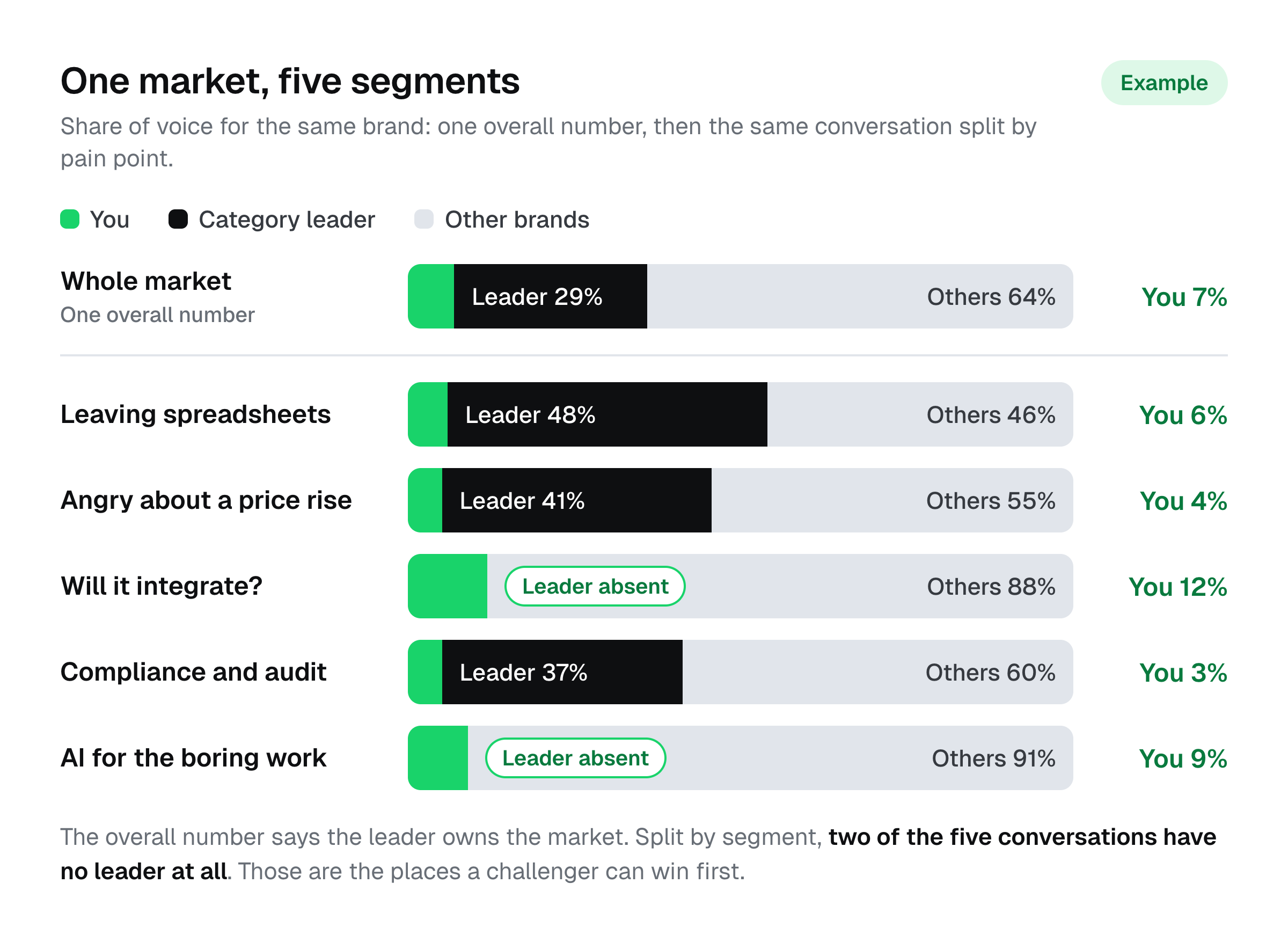
Take the example above. Overall, the leader holds 29% and you hold 7%: fight for second place, says the number. Split the same conversation into five pain points and two have no leader at all. In 'Will it integrate?' you already hold 12% and nobody holds much more. That is not a market to take from someone. It is a conversation nobody has claimed.
Segments also split by language and region. A brand entering Germany should not read the German conversation through English keywords, and a brand selling in three countries should expect three readings, not one. Entering a new market covers this in detail.
Add direction and the ranking changes again. A 4% share of a conversation that is growing fast is often worth more than 15% of one that is shrinking. Level tells you where you stand. Direction tells you where the market is going. Spectre shows every segment with its size, its direction and a 24-week forecast side by side for this reason.
What is a good share of voice?
There is no universal good share of voice. The number only means something relative to your share of market, to the leader in each segment, and to your own reading last period. A 10% share is strong if you hold 5% of the market. It is weak if you hold 20% and the number is falling.
- Against share of market. Above it, you are set to grow. Below it, you are set to shrink. This is the comparison to show the board.
- Against the segment leader. Not the overall leader: the brand that holds most of each specific conversation, often a different name in each segment.
- Against last period. Direction beats level. A rising 6% is a better story than a flat 15%.
How do you forecast share of voice?
A share of voice forecast starts from today's level in each segment, reads the direction the conversation is moving, and predicts where your share is likely to be over the next 24 weeks as a range rather than a single number. Refresh it monthly, so each new reading either confirms the forecast or tells you to change course.
Measuring tells you where you stand. Forecasting tells you where to put next quarter's effort, which is what the budget meeting is actually about. What is predictive marketing? covers the wider cycle. A useful forecast has three parts:
- 1Today's level, per segment, per language and per surface.
- 2Direction. Is the conversation growing or shrinking, and is your share rising or falling inside it?
- 3A 24-week range. Conservative, moderate and aggressive cases for where your share lands if you invest. Long enough for the work to change a conversation, short enough to check before the next budget cycle.
The ranking that falls out is the plan. Segment A: the moderate case takes you from 4% to 20% in 24 weeks, with a good chance of passing the segment leader. Segment B: barely moves whatever you spend. Segment C: already yours, defend it. Spectre's forecast is built this way and refreshed monthly, with the pages, content and ads to move each segment made by our team and agents and approved by a human before anything ships.
Common share of voice mistakes
- Counting only your own channels. Your followers, traffic and branded searches are your slice of the conversation, not the conversation. You need the denominator: every brand, everywhere the market talks.
- One number for the whole market. Averages hide the segments where the leader is absent and the ones where you are quietly losing.
- Ignoring language and region. A market that talks in three languages is three conversations. An English-only reading of a German market is a reading of the expats.
- Measuring once. A single reading has no direction. Monthly at a minimum, weekly during a launch or a competitor response.
- Treating it as a vanity metric. On its own it is a number that goes up and down. Compared with share of market and forecast forward, it is a decision.
- Forgetting AI assistants. A growing share of category shortlists is now written by an assistant. Measure social conversation and search only and you miss the fastest-moving surface.
You don't need to win the whole market. You need to win the conversations nobody else is in yet.
Frequently asked questions
Is share of voice the same as share of search?
No. Share of search is one way to measure share of voice: your brand's searches as a share of all brand searches in the category. It is useful because it is easy to track over time. But it misses the social conversation, where pain points appear first, and the AI assistant answers where shortlists are now written. Use all three.
Can share of voice be measured in AI assistants?
Yes. Ask the questions a buyer in your category would ask, in each language the market speaks, and record which brands are named in the answers. Your share of those mentions is your share of voice in AI answers. It often differs sharply from your share in search, and the gap shows you where to work.
Does a high share of voice guarantee growth?
No. It raises the odds. Share of voice above share of market is one of the most reliable patterns in marketing, but it assumes the mentions are broadly positive and the segment has demand. A brand dominating a conversation about its own price rise is not about to grow. Read the sentiment and the direction, not only the share.
How is a share of voice forecast different from a trend line?
A trend line extends the past. A forecast reads the whole conversation, including competitors and the direction of each segment, and gives you a range for the next 24 weeks under different levels of investment. It is refreshed monthly, so it corrects itself. A trend line only tells you what happens if nothing changes, and something always does.
See what Spectre would say about your market.
30 minutes. Bring the market you're entering or the competitor you're up against.